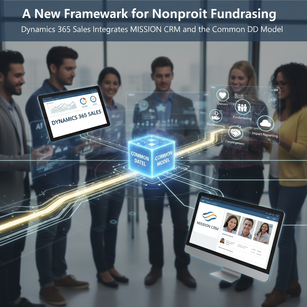
A New Framework for Nonprofit Fundraising: Dynamics 365 Sales Integrates MISSION CRM and the Common Data Model
Microsoft’s latest initiative brings a focused set of capabilities to nonprofit organizations by integrating a fundraising and engagement solution into Dynamics 365 Sales, built in partnership with MISSION CRM and underpinned by the Common Data Model for Nonprofits. The offering is designed to modernize how charities and non-governmental organizations manage donors, campaigns and stewardship activities by providing a single, cloud-first platform that consolidates previously fragmented data streams. Instead of treating fundraising as an add-on, this approach embeds donor management and engagement workflows directly into a CRM platform already used by many organizations for constituent relationship management and business processes. The result is intended to be a cleaner, more maintainable stack that reduces duplicate data, shortens time-to-value for new initiatives and aligns fundraising metrics with operational systems across Microsoft services.
A core technical enabler of the new solution is the Common Data Model for Nonprofits. By adopting a standardized schema for donors, gifts, grants, affiliations and outcomes, nonprofits can now unify donor data across Microsoft services—Dynamics 365, Power Platform, Outlook, Teams and Azure—without bespoke point-to-point mappings for every integration. Data stored in Dataverse using the Common Data Model becomes immediately more portable and actionable: Power BI dashboards, automated Power Automate flows, and model-driven Power Apps can all consume the same canonical entities and fields. For ISVs and technology partners, the standardized model simplifies integration patterns. Independent software vendors can certify connectors and extensions that work out of the box for any nonprofit using the CDM, reducing development overhead and ensuring consistent interpretation of fundraising-relevant records.
Practically, the unified platform promises concrete improvements in transparency, reporting and scalability—areas that often hold back growth and trust-building for nonprofits. With consolidated donor records and gift histories, organizations gain reliable audit trails and clearer views of donor journeys, enabling compliance with donor intent and regulatory reporting. Real-world examples, such as the work Microsoft highlighted with Right To Play, illustrate how the solution can scale across campaigns and geographies: a single donor’s engagement history and giving patterns remain intact whether the interaction occurred via email, web donation, in-person event or multinational grant processing. This unified visibility supports donor stewardship, helps identify major-gift prospects, and drives more personalized outreach. On the scalability front, leveraging Azure’s cloud services and Dynamics 365 architecture means organizations can grow without the manual reconfiguration that plagued older, siloed systems.
For the partner and ISV ecosystem, the introduction of a fundraising-and-engagement capability within Dynamics 365 Sales changes how vendors build and sell solutions to the nonprofit sector. Rather than developing full-stack donor databases, many ISVs can focus on vertical value—such as recurring-giving processors, event-management modules or specialized grant-management tools—that plug into the common data model. This not only shortens time to market for third-party solutions but also reduces the integration debt nonprofits face when composing their technology stack. Implementation partners and consultants benefit from repeatable deployment patterns and accelerators based on Dynamics 365 and MISSION CRM best practices, and can offer managed services around data migration, workflow design and analytics. At the same time, Microsoft’s security, compliance and privacy controls are available to nonprofit customers, making it easier to meet funder requirements and protect sensitive donor data.
Adoption will require careful planning and organizational change management, but the potential returns are significant. Nonprofits should view this development as an opportunity to reassess their data hygiene, governance and donor engagement strategies. Key first steps include inventorying existing donor systems and data sources, mapping them to the Common Data Model, and prioritizing high-impact processes—major-donor cultivation, recurring-donation retention, or grant reporting—for early migration. Training front-line fundraising and program teams on Dynamics 365 Sales workflows and the new integrated interfaces will be critical to realizing productivity gains. Organizations should also account for phased migrations and pilot programs to minimize disruption; smaller pilots can prove the behavioral and financial benefits before wider rollouts. For those concerned about customization limits, the Power Platform and Dataverse still permit tailored entities and business rules while preserving the compatibility advantages of the CDM.
Overall, embedding fundraising and engagement capabilities within the Dynamics 365 Sales ecosystem, supported by MISSION CRM and the Common Data Model for Nonprofits, represents a strategic step toward a more unified, scalable and transparent nonprofit technology landscape. It reframes fundraising as a core operational capability rather than a siloed function, enabling tighter alignment between development, programs and finance. The approach encourages an ecosystem where ISVs add differentiated value on top of a shared data foundation and where organizations can pivot quickly as fundraising channels and donor expectations evolve. For nonprofits willing to invest in migration planning, governance and people, the new solution promises not just technical consolidation, but better-informed stewardship, stronger donor relationships and the operational capacity to pursue larger and more complex missions.