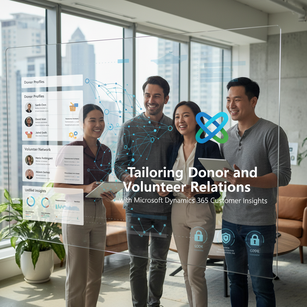
Tailoring Donor and Volunteer Relations with Microsoft Dynamics 365 Customer Insights
Nonprofit organizations today face a paradox: supporters expect communication and engagement that feels personal and relevant, yet many charities and mission-driven groups struggle with fragmented data systems that make personalization difficult. Donors give through multiple channels, volunteers sign up on different platforms, and legacy systems keep records locked in silos. The result is missed opportunities—blanket appeals that don’t resonate, underutilized volunteer talent, and supporters who disengage because communications feel generic or poorly timed. To boost engagement and deepen relationships, nonprofits must move beyond one-size-fits-all outreach and instead tailor experiences to individual preferences, histories, and likelihood to act. That starts with solving the technical and organizational challenge of unified data so teams can see each supporter holistically and respond intelligently. Addressing this gap is not simply a matter of convenience; it’s essential to increasing lifetime value, improving retention, and making every contact point an opportunity to further mission impact.
Microsoft Dynamics 365 Customer Insights is designed to close that gap by unifying supporter data into a single, usable profile and applying AI to resolve identity, segment audiences, and surface predictive signals. At its core, Customer Insights ingests data from CRM systems, fundraising platforms, event registrations, email marketing tools, social channels, and volunteer management systems, then standardizes and consolidates records. Its identity resolution capabilities use machine learning to match and merge duplicate or fragmented records—so a donor who gave at an event, online, and via mail is recognized as one person. Once identities are resolved, the platform builds unified supporter profiles that include giving history, engagement behavior, demographic details, and volunteer skills or availability. This consolidated view gives development and engagement teams a reliable foundation for personalization and prevents the errors and inefficiencies that come from siloed data.
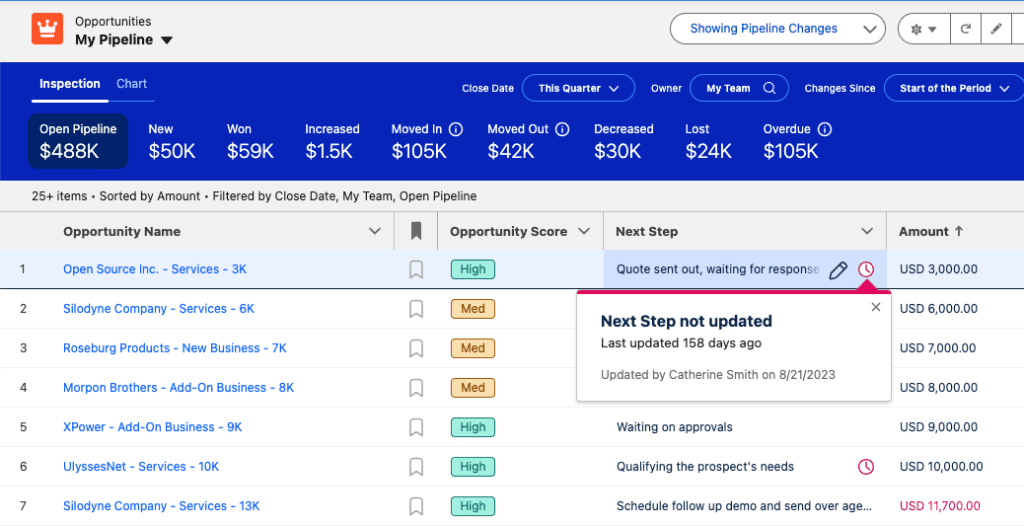
With unified profiles in place, nonprofits can use segmentation and predictive insights to target outreach precisely. Customer Insights supports both rule-based segmentation (for example, monthly donors who attended a recent event) and AI-driven segments based on patterns in supporter behavior and similarity to high-value cohorts. Predictive models can generate propensity scores—likelihood to give again, to upgrade, to volunteer for a specific role, or to attend an event—helping organizations prioritize who to call, email, or cultivate in person. These models also fuel dynamic content and journey orchestration: an automated sequence might invite a high-propensity volunteer to a leadership opportunity, while a lower-key supporter receives nurturing content designed to build trust. The platform integrates with marketing automation, fundraising tools, and outreach channels so personalized messages—tailored asks, custom stewardship reports, or matched volunteer opportunities—reach supporters where they prefer to engage. Real-world use cases include increasing major gift conversions by surfacing warm prospects, improving volunteer retention through better role matches, and boosting event attendance with targeted invites to those most likely to participate.
Security and privacy are foundational to maintaining supporter trust as personalization scales, and Customer Insights is built with that in mind. The platform enables GDPR-compliant security practices by supporting consent management, data minimization, and purpose-based access controls, ensuring that any personalization respects the legal and ethical expectations of supporters. Role-based access, encryption in transit and at rest, and detailed audit trails help nonprofits demonstrate compliance and govern who can see or act on sensitive supporter information. Data residency options and integration with compliance frameworks mean organizations can align platform configuration with regional regulations. Importantly, privacy-preserving features allow teams to use aggregated or anonymized insights where necessary, and to honor opt-outs and communication preferences automatically. This combination of advanced personalization and robust privacy controls ensures that tailoring outreach does not come at the expense of supporter rights or organizational accountability.
Getting started with this approach requires both technical steps and change management. First, map existing data sources and prioritize the most valuable integrations—fundraising, volunteer management, and event systems are typical starting points. Next, import and normalize data into a Customer Insights instance, then configure identity resolution rules and review suggested matches to refine accuracy. Define segmentation strategies and the key outcomes you want to influence (retention, upgrade, conversion, volunteer utilization), and experiment with predictive models to produce actionable propensity scores. Integrate those segments into your engagement workflows—email journeys, phone calls by development officers, personalized mailings, or volunteer scheduling systems—and set up measurement frameworks (open rates, donation conversion, volunteer hours, retention rates) to assess impact. Train staff on interpreting unified profiles and insights so they can craft appropriate messages, and establish governance policies for data access and consent handling. When implemented thoughtfully, this combination of unified data, AI-driven identity resolution, segmentation and predictive insights, and GDPR-compliant security transforms supporter engagement from scattershot to strategic, helping nonprofits build deeper, more meaningful relationships that advance their mission.